July 1st, 2011
Customer Love: Gary Lord
Having two companies can be a lot like having two children. You love each one passionately and strive to give them equal amounts of time and attention. It can be hard to maintain that balance, though, when one or the other becomes more “needy”. And so, while lately I have been focusing a lot on my “oldest” child Royal Design Studio, which sells reusable, “designer” mylar stencils since 1994, my “baby” Modello Designs (one-time-use vinyl masking stencils) has been feeling neglected and is frankly starting to get a bit jealous. And so, my darling Modello Designs, I am committing some quality time to spend with you, and promise to show you off and brag about you here once a week!
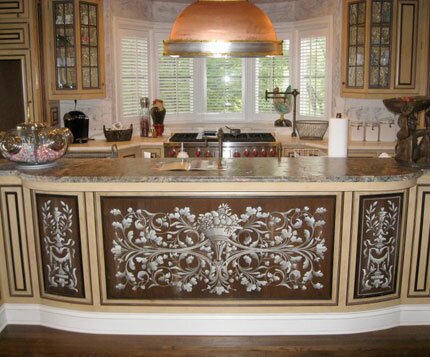
This will not be hard, as you can do amazing things! While your Royal stencil sister excels at creating beautiful repetitive pattern, YOU truly shine when it comes to creating custom-designed, custom fit patterns. Take this recent project by my good friend and Italy traveling buddy, Gary Lord, of Prismatic Painting Studio and Gary Lord Wall Options.
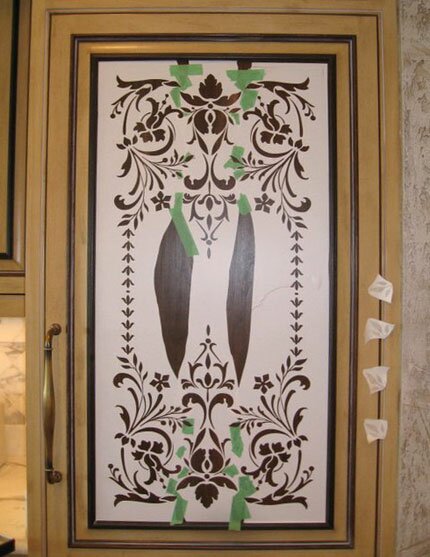
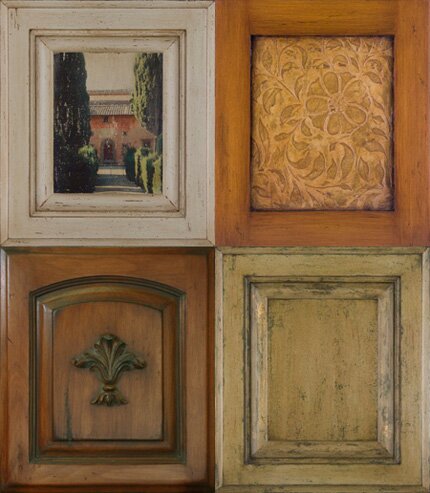
Gary worked with our in-house custom Modello designer extraordinaire, Michelle, to modify some of our existing designs for an amazing kitchen cabinet conversion.
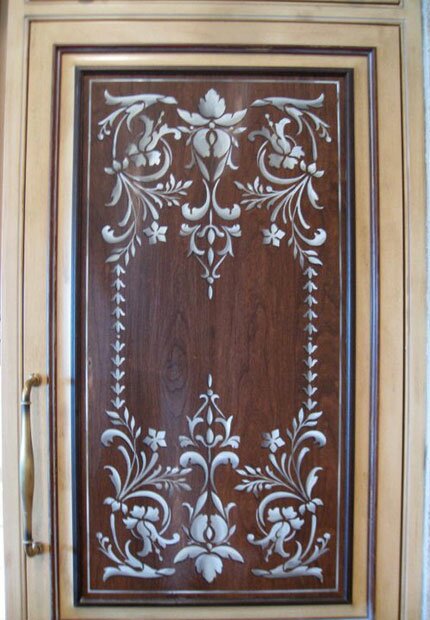
Each Modello vinyl stencil pattern was designed to fit the various door panel spaces perfectly, so that Gary could simply place them and focus on his artistry rather than the frustration of trying to fit the patterns to individual spaces.
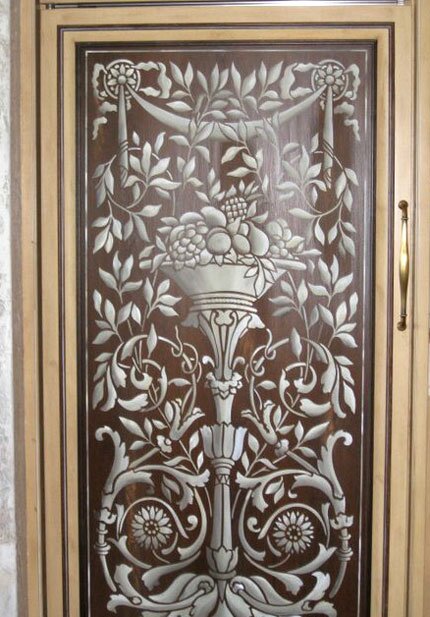
Gary used an elegant trompe l’oeil painting technique that Alison Wooley shared on one of our painting trips to Italy.
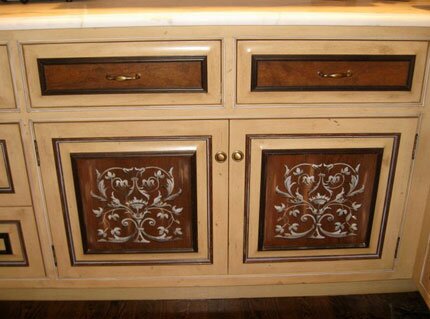
Using multiple values of the same color and applying some hand painted touches over a quickly stenciled base color that was applied through the Modello patterns, Gary created a kitchen masterpiece! What will our Modello customers cook up next?! Stay tuned, and see….
January 18th, 2011
Here and There
Being the busy little bee that I am, I thought I would just point you in some inspiring directions around the web today to some fabulous blog posts that have special meanings to me.
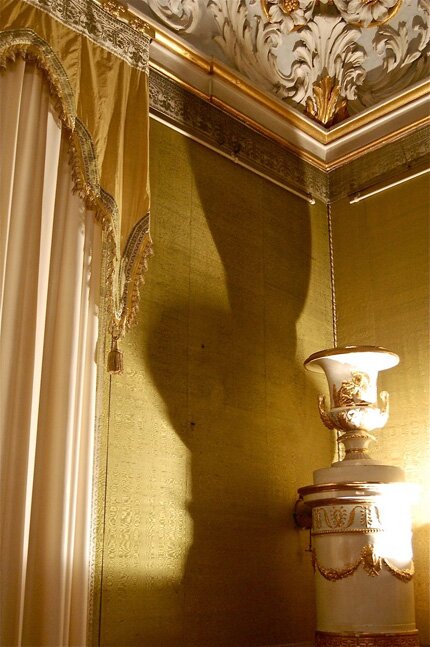
Debbie Hayes has a beautiful eye and a beautiful blog, FauxPlusDesign, where she shares her decorative art, photography, travels, and interesting musings about all of the above. This post features some super juicy photos of the private tour of the Palazzo Corsini in Florence, Italy that was arranged on our decorative painting adventure last October. We were honored that the lovely Contessa Corsini herself led us through the palace, sharing her family history and great taste in art and architecture! Debbie’s photos truly capture the splendor of this amazing place on the bank of the Arno river.
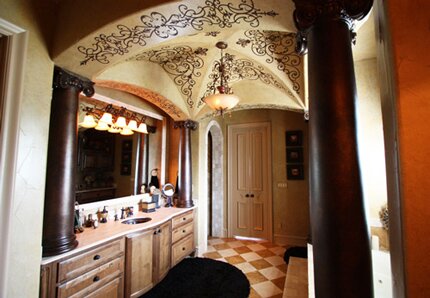
Regina Garay has a fabulous design and decorating blog, Fauxology, where she shares daily inspiration on design and color trends, decorative painting, and a whole host of other visual goodies. It’s a “must read” for professional creatives and design devotees. All this week, she is featuring groin ceilings, and TODAY’S feature just happens to be on using our Modello Masking Stencil Patterns for artful decoration of this architectural asset.
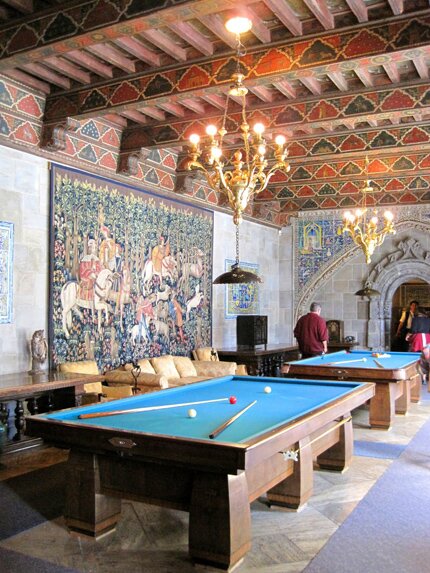
A great new blog discovery for me this past weekend (thanks Anna Sadler!) is ArchitectDesign. Stefan Murray has recently been featuring a series of posts and extensive photo essays on Hearst Castle. Now, as you may recall, Modello Designs and Royal Design Studio have recently been selected to become licensees for the Hearst Castle Collection, and I am currently in the process of developing stencil patterns based on the endless array of decorative painting and design details that are contained in this national treasure. If you haven’t been to Hearst Castle, you can travel through Stefan’s blog posts. Enjoy the tour!
January 13th, 2011
Corsini Damask Stencil Art
One of the more recent additions to the Royal Design Studio stencil collection is the Corsini Damask Stencil. This stencil pattern was developed especially for the Italy painting trip that I hosted last October with my good buds Gary Lord and Alison Wooley. It was a special trip, filled with lots of fun and good painting friends. The Corsini Damask Stencil gets it’s name from the Corsini family-a blessed and noble Italian family with a long and rich history who also happen to own villas, palazzos, and castles througout Italy, including the Castello di Casigliano where we were fortunate to work, stay, and play for a second time in the last three years.
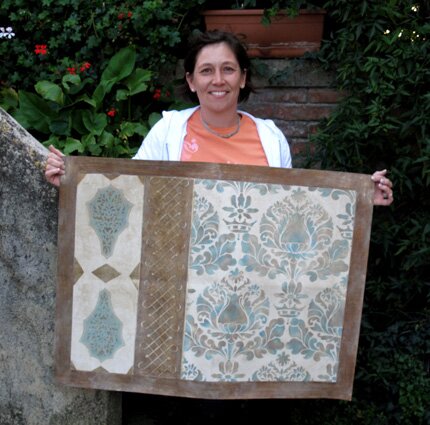
For my class project, I decided to give the students a limited range of stencils, Modello Masking Stencil Patterns, some interesting paint techniques, a limited color palette, and a large piece of canvas. Basically, I turned them loose to exercise their creativity and the results were fantabulous!
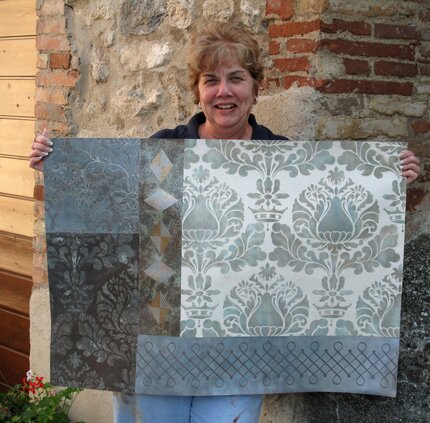
Each canvas became a unique work of art and it was so inspiring to see how each person interpreted the patterns and colors in a special way.
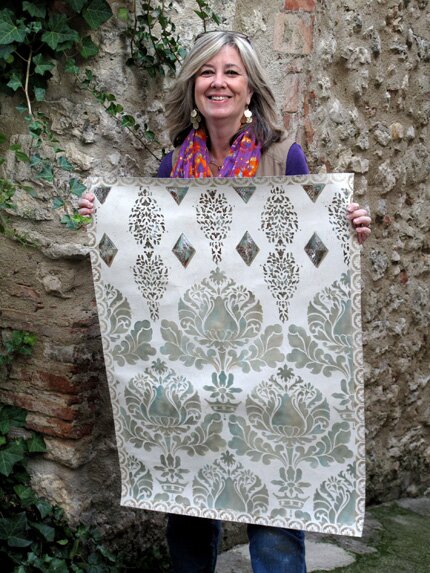
Applying stencil patterns as canvas art frees you to really explore color, texture, shape, and scale in a different way from wall stenciling. You can be bolder and more creative with your color combinations, and easily introduce mediums other than paint, such as gilding, plasters, and waxes. Basically, anything goes!
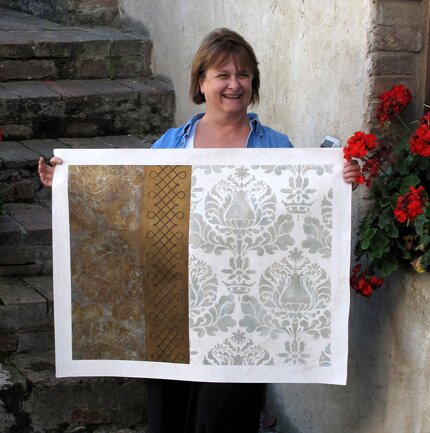
This canvas art was done on Roclon, an amazing material that is actually canvas laminated to both sides of a thin plastic core. It is very flexible, wrinkle resistant, doesn’t shrink, and comes ready to apply paint, plaster, metallics, or whatever medium you want to work in. Alternatively, you can do stenciled canvas art on stretched canvas that will be ready to hang. The type of canvas art shown here is ideal for hanging from a decorative curtain rod, as you would a tapestry. Artwork done on the Roclon cloth can also be permanently affixed to a wall with wallpaper paste. My fabulous artist friends shown here are (top to bottom) Lauren Gaines, Nancy Jones, Debbie Hayes, and Barb Skivington. Of course, you can use the Corsini Damask Stencil very nicely on a wall too!
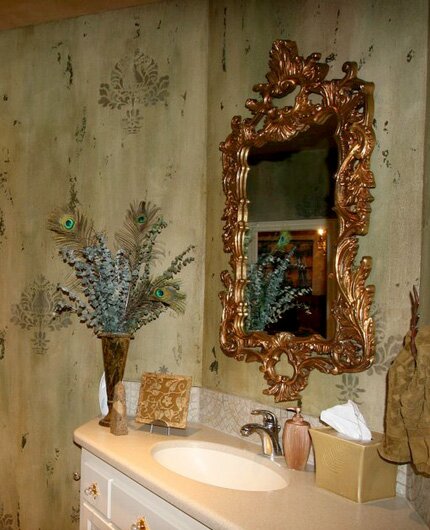
This room above was done by Sass Lassly, another great addition to our Italy painting adventure, in her own bathroom. Note the random application of the stenciling. This is a great way to add pattern quickly and artistically.
I hope this post inspired you! Hint: Stenciled canvas art is also a great way to use up those little bits of paint and plaster you have lying around, as well as maybe revisiting some stencil patterns you may not have used in awhile. The 3074 Corsini Damask Stencil is available in both a large and small version. The small version is shown in all photos above.
November 21st, 2010
Set in Stone
I was so thankful this past October that on our last day in Florence on our Italy Painting Trip, that Alison pointed a small group of us in the direction of the Pietre Dure Museum, officially called the Opificio della Pietre Dure. This amazing little place is tucked on a side street just around the corner from the lines of people waiting to see Michelangelo’s David at the Accademia. We were the only three people in attendance the whole time we were there! How lovely to escape the crowds and spend some quiet time contemplating the stone marquetry and scagliola work of centuries of fine Florentine craftsmen. Below are some of my favorite photos taken on site….
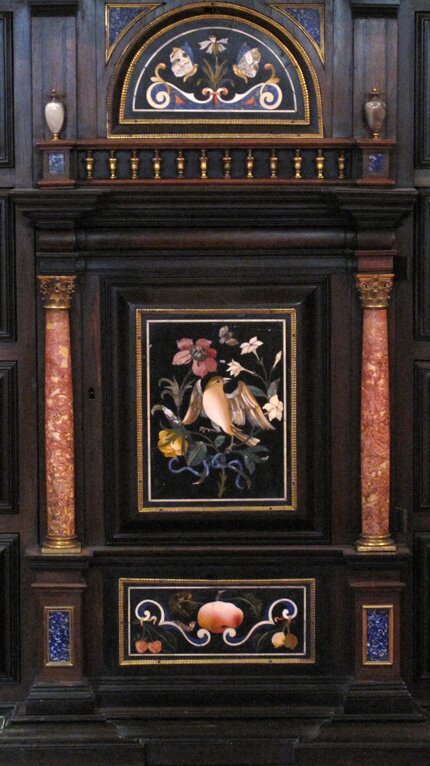
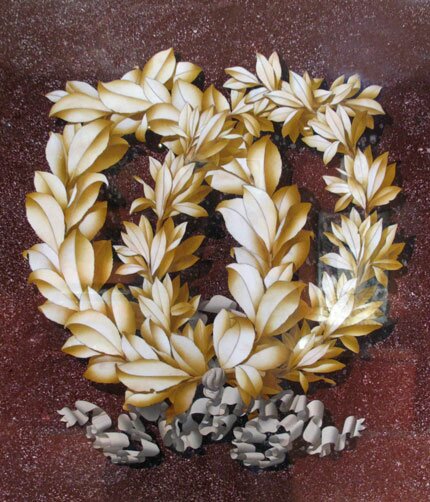
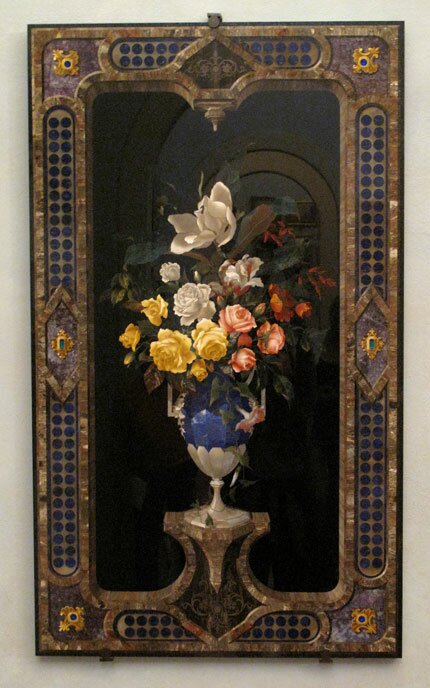
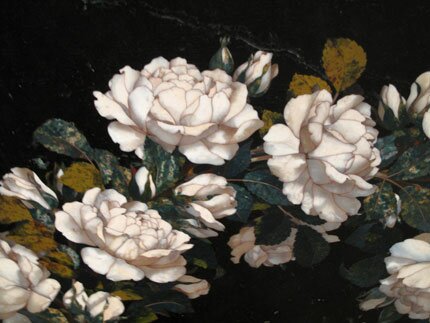
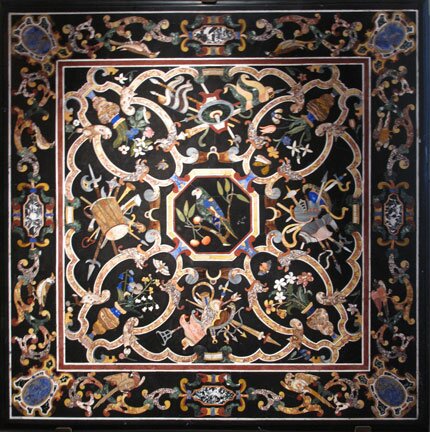
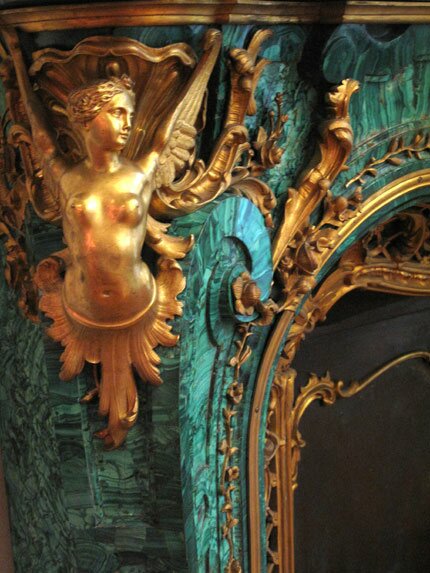
My favorite photo is of this ornate and amazing malachite fireplace surround, detailed out with gilded plasterwork. They just don’t make ‘em like this any more kids!!
Alison had recommended this museum as being “easily digestable”, and the focus on JUST this type of artistry really helps you hone in, enjoy, and appreicate the amount of skill and detail that this kind of artwork requires! Upstairs there is even an extensive display of the tools and “machines’ that were employed by the artisans, as well as a beautiful selection of all of the precious and semi-precious stones and marbles that were routinely incorporated. I HIGHLY recommend that this museum be moved to the top of your list if you find yourself lucky enough to be in Florence!
You can find more interesting details about the history of the this “court laboratory” turned museum, and the beauty it contains here, in English.
October 26th, 2010
Riccardo Barthel
Well, I’ve made a decision. When my dreams come true, I will buy a villa or palazzo in Italy. While I’m dreaming, I might as well just make a commitment to visit Riccardo Barthel in Florence because, you know, I am going to need HELP decorating my new digs.
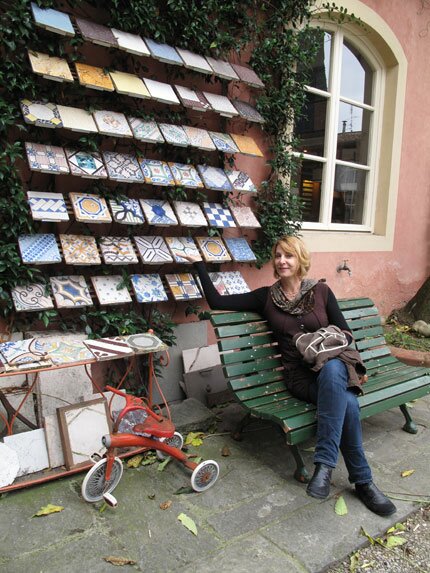
This amazing design store was right next to the hotel where our Italy Painting Tour group stayed a couple of weeks ago.
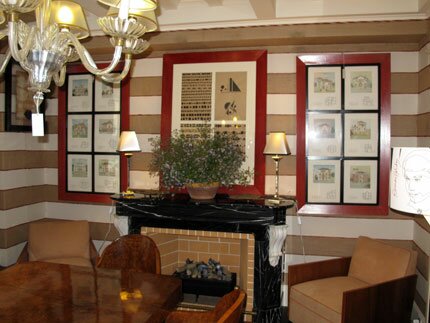
They specialize in, well, LOTS of amazing things, it seems….
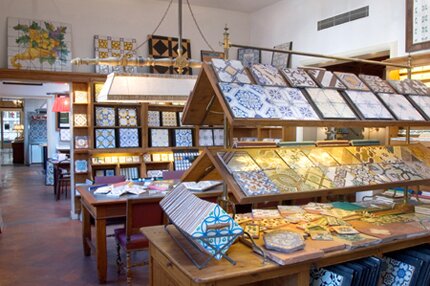
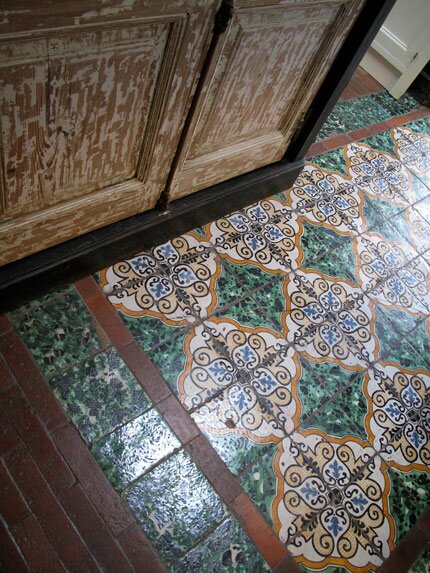
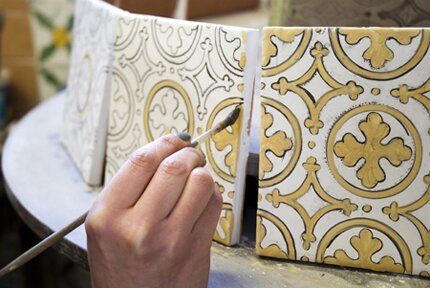
…like a seemingly endless variety of hand painted tiles for floors, walls, backsplashes, and countertops.
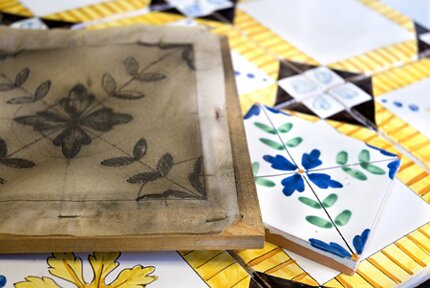
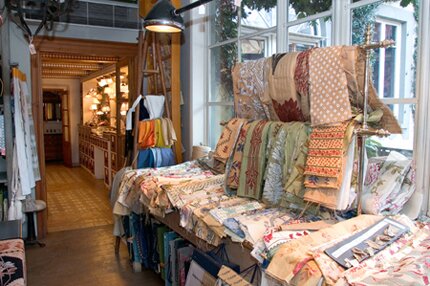
They also featured a lot of gorgeous custom furniture, frames, mirrors, furniture, fabrics, and fine art…
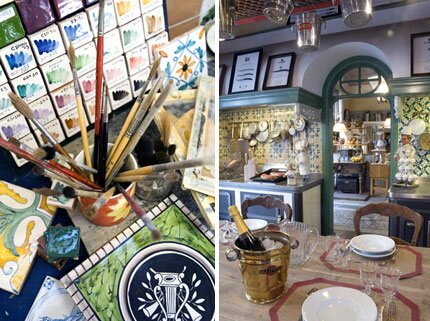
…all set amidst unique displays….
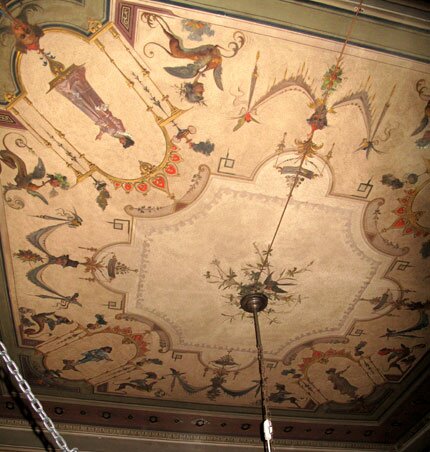
,,,that contrasted contemporary wall treatments with centuries-old painted ceilings.
There was also had a wonderful “shed” filled with antiques ready to be rehabbed and restored-or sold “as is”.
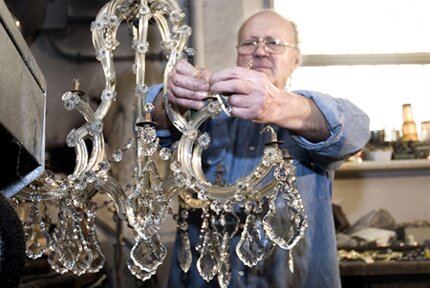
Truly amazing (and bank breaking) though, were their kitchen and bath fixtures.
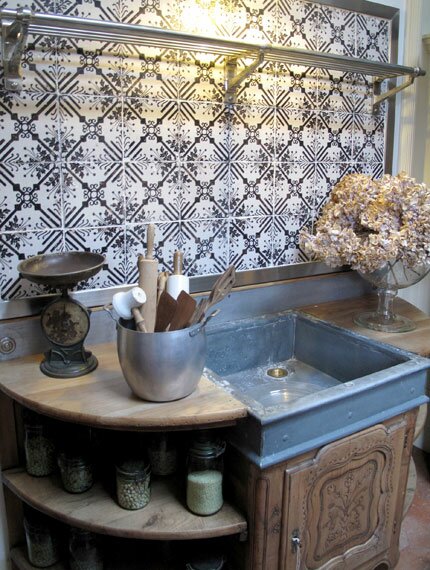
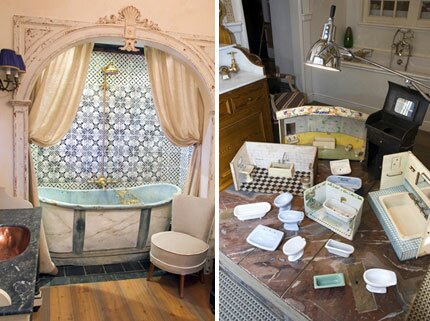
Unfortunately, everything there was completely out of my price range, but WAIT, I AM dreaming here…..
The next time you are “museumed-out” in Florence, check out the dreamy Riccardo Barthel store near Porto Romano in Oltrarno for yourself!
February 28th, 2010
Faux Plus Design
I’d like to welcome another friend and decorative finisher to the blogging world. Debbie Hayes is a very talented Greensboro, NC decorative artist who has been featured a few times before on this blog.
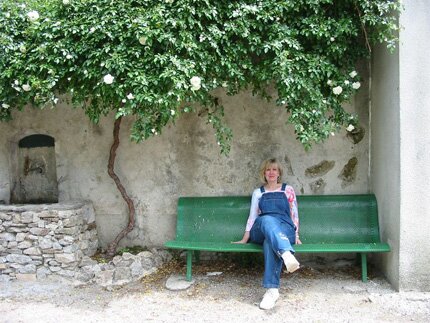
Her new blog, Faux Plus Design showcases her photography and literary talents (she’s a former newspaper editor) as well as her artistic skills. Debbie has accompanied me on several of the painting adventures abroad that I’ve been involved with in the past, including France, Morocco, and Italy.
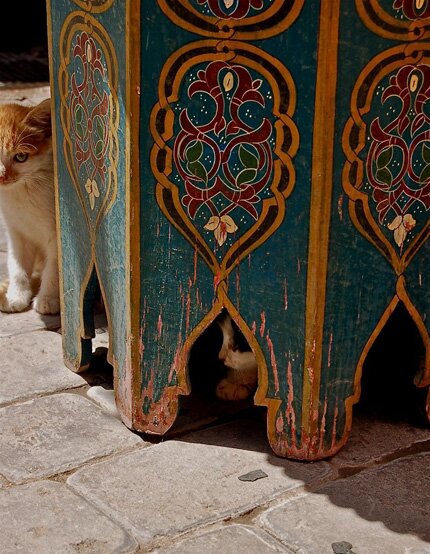
She talks about these (and her ongoing wanderlust) in some recent blog posts, including one on Moroccan Souk kitties….
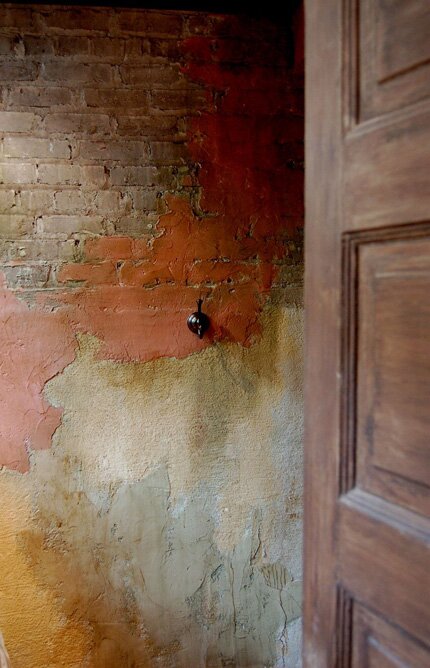
…and one on our last trip to Italy.
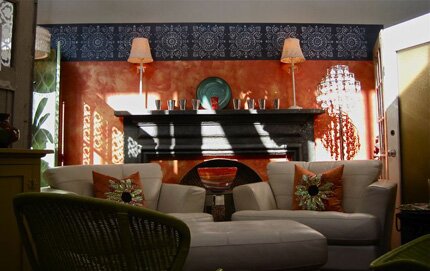
Some of these travels have inspired the color-saturated decoration of her amazing, inviting studio!
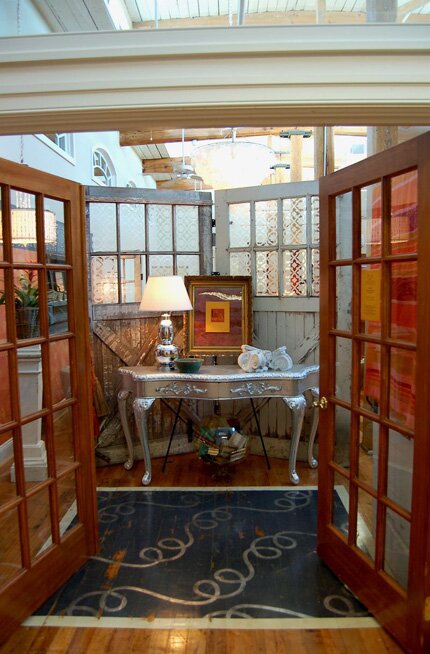
I am happy that Debbie (and her talents and ever-ready camera) will be joining us on our next trip to Italy this coming Fall. To find out more about trips to both Italy and Morocco, click here….
February 21st, 2010
Inspired by Italy
You may have noticed that I have been absolutely HORRIBLE at accomplishing regular blog postings lately. Between a multitude of major new projects, trade show preparations, planning painting trips, and a honeymoon and a wedding (in that order), there seems to be precious little time to stop and EXPLAIN what I’m up to (and up against!). SO-this post is designed to cover a few topics at once, based somewhat loosely around a theme. Here goes….
Aaah, Italia. So enchanting, so delicioso, so artistically inspiring!! Italy is just one of the countries that have inspired the finishes offered in the upcoming European Cabinet Finishes class that we will be hosting here at the studio in June. Barb Skivington’s class draws from inspiration gained from past painting trips with me to both Italy and France, as well as finishes interpreted from the highly popular new Belgian look and what I see as an emerging trend towards Spanish-inspired design and fashion.
If you’d like to explore the possibilities and benefits gained from taking this class, Barb and I have created an informative free 30-minute webinar for the new Design Your Success site (another new project!) that details these elegant finishes and their possibilities for application. Barb has an extensive background as an artist AND and educator and was featured in this recent profile in The Faux Finisher that I authored.
Speaking of inspiring trips to Italy, and attempting a not so subtle segue; there is an upcoming opportunity for YOU to join us on a return trip to enchanting Italy this coming October. Gary Lord, Alison Woolley and myself are planning a return to the sights of two previous painting adventure tours, the Castello di Casigliano in Umbria and La Fattoria di Maiano in Florence with our upcoming Art in the Heart of Italy trip.
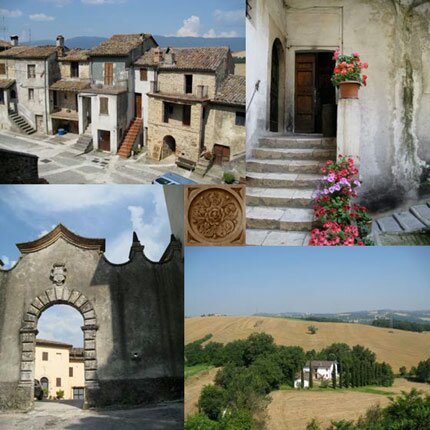
These trips offer so much in addition to all the inspiration that the natural and man-made beauty of Italy provides.
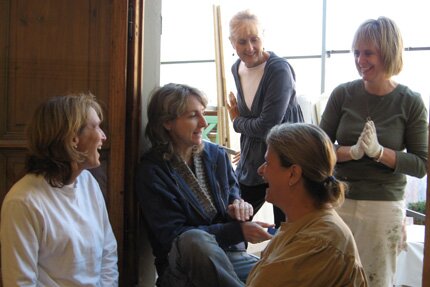
The friendships that are formed through shared experiences…
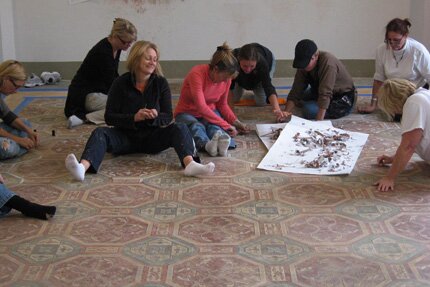
and educational classes and group painting projects is truly unique and special. Are you feeling inspired?!
European Cabinet Finishes Class
Art in the Heart of Italy Trip
October 28th, 2009
A Table or Two Please
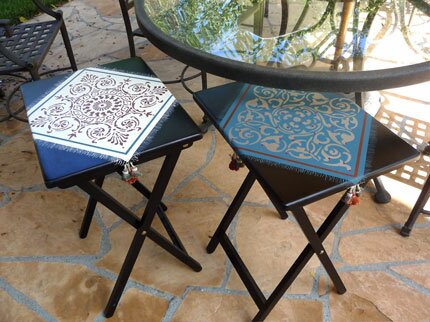
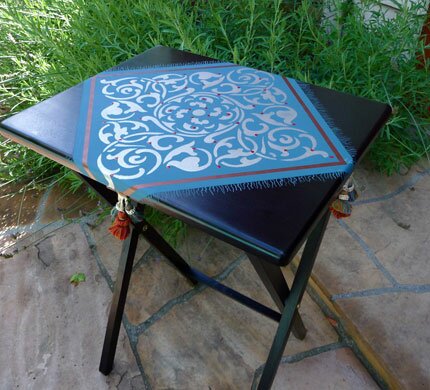
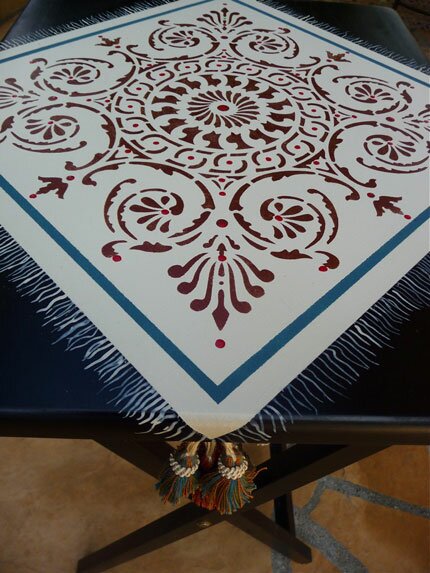
Just in time for you to start thinking about all those handcrafted Christmas gifts you’ll be giving this year….I give you a fabulous little stenciled side table treatment from Dagmar Alexandersson! Dagmar created these lovely custom tables recently as a wedding present. She used acrylic paints and tile stencils from Royal Design Studio to create the look of embroidered table cloths on some simple fold-up tray tables. I adore the added tassels!
Dagmar was a welcome addition to our group on the Umbria Italy Painting Trip with Gary Lord and myself last May. Gary and I are finalizing the fabulous details for a return trip to Umbria and Tuscany in early October 2010. Please email me at melanie(at)modellodesigns.com if you’d like to be placed on the priority list for notification when we open up registrations in a couple of weeks.
May 27th, 2009
Foilin Around
Metallic Foils are smokin’ hot! They’ve been around the decorative painting world for years, but I’ve just started playing around with them a year or so ago. Sometimes, I’m a little slow to get to the table….but now I’m a certified foil addict and it seems like every new surface finish I start involves the thought, “hmmmm, how can I get some foil into this…”
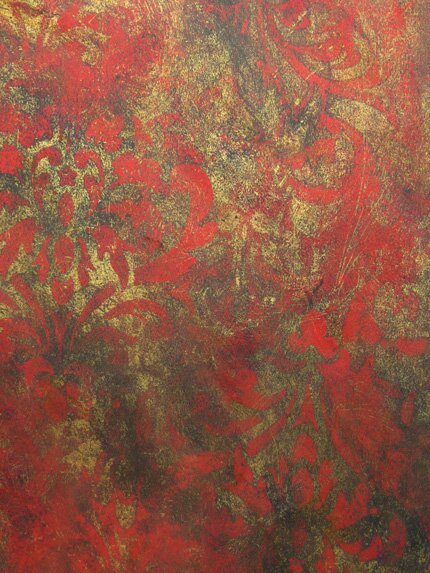
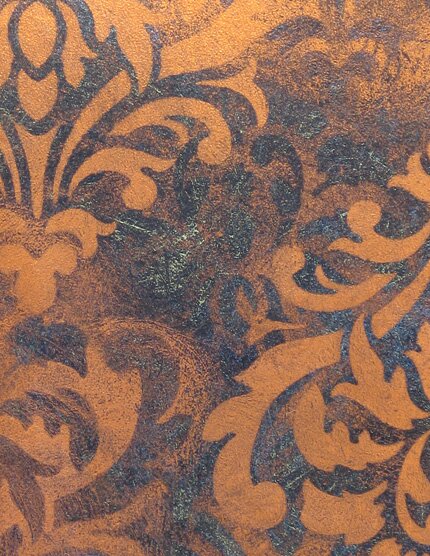
SO, when it came time to create some new finishes to teach to our artist group in Italy, out came the foils. I wanted to do something cool (and quick) so hit on the idea of using stencils to create a multi-layer foil finish in JUST ONE LAYER.
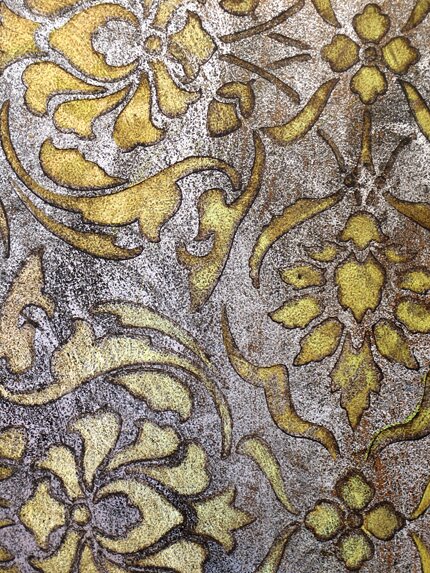
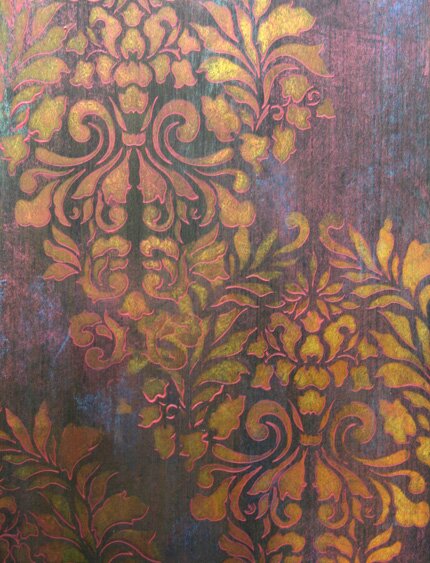
On some of them, I expanded by going back and highlighting the pattern with some additional color and on some used the reverse image I was able to get with the foil after applying in through the stencil.
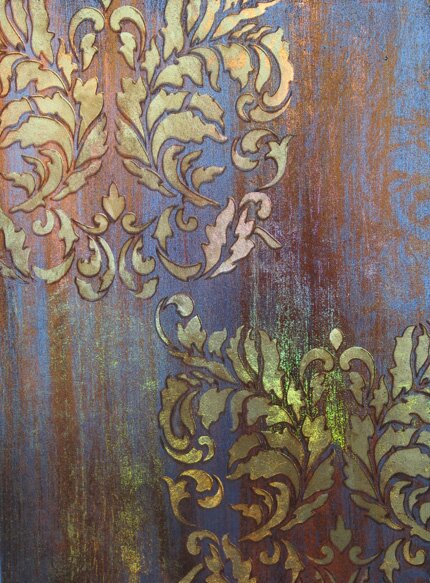
It’s WAY cool!
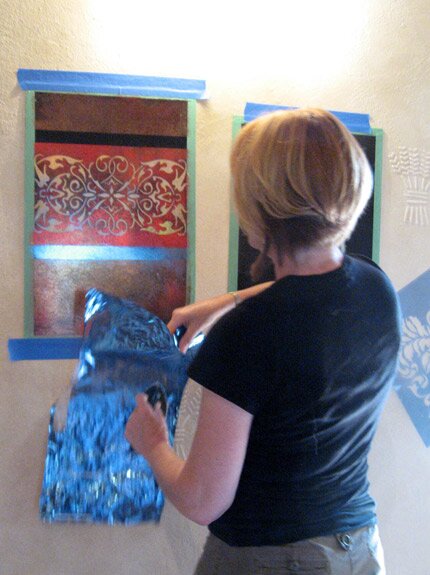
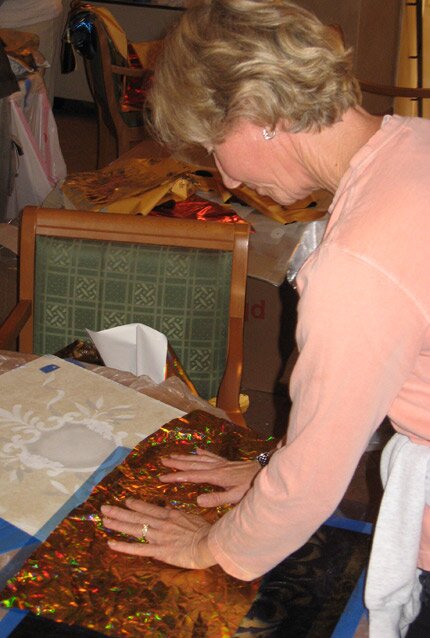
So, I taught two of these new finishes at our class in Italy, and everyone’s samples turned out awesome-and we discovered even MORE options.
One of our group, Pattie Nickel, loved these techniques SO much she did this fabulous accent wall almost immediately after unpacking her bags.
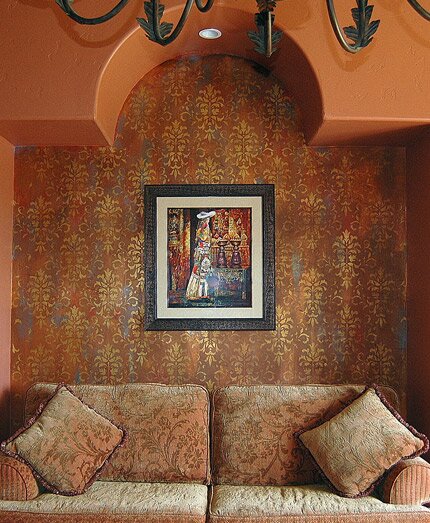
Isn’t this just “WOW”?! She used one of our most popular stencil patterns, the Foliate Damask Allover stencil. I’m working on some instructional material and “recipes” for these techniques to include a mini-book and DVD that I hope to have in time for the IDAL Convention in July, so I’ll be foilin’ around in my studio quite a bit in the next few weeks…..
May 22nd, 2009
La Dolce Vita at Casigliano
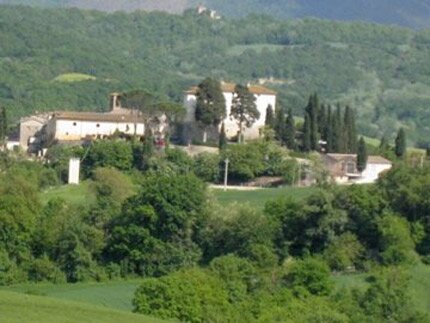
Yes, we lived the sweet life for a week at Castello di Casigliano. It had rained pretty much the whole month of April there (the most in 200 years), but that was all in the past and the sun shone brightly 0n the green hills (low 70′s, thank you) for us!
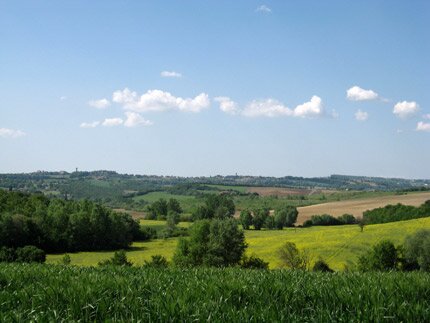
The region of Umbria is known as “the green heard of Italy”. It’s between Florence and Rome. Not as touristy as Tuscany, but still with plenty of wine, medievel hill towns, gorgeous views, and yummy fresh local recipes.
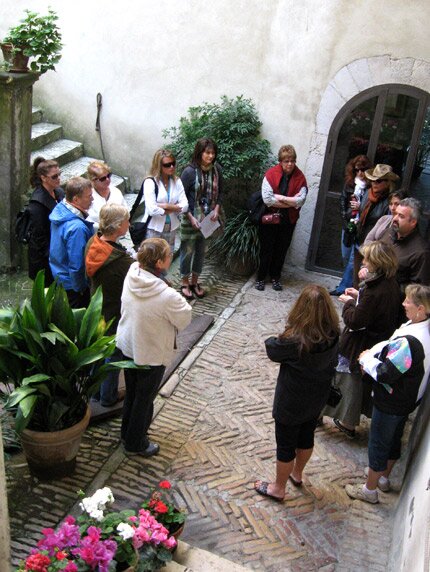
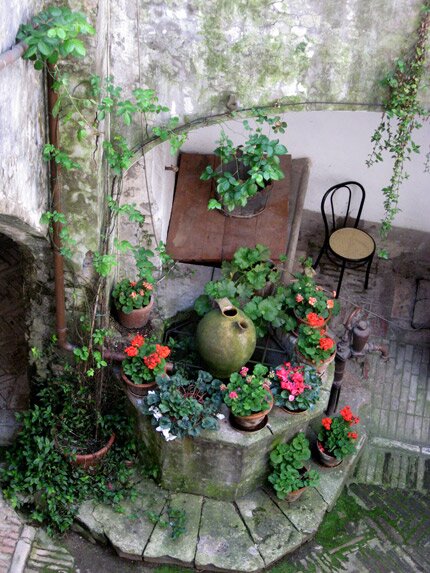
The Castello has a storied history, included stays by Popes, family murders, and oooooh, a current ghost perhaps? Romano gave us a tour on our first day and the photo above shows the group in the beautiful courtyard.
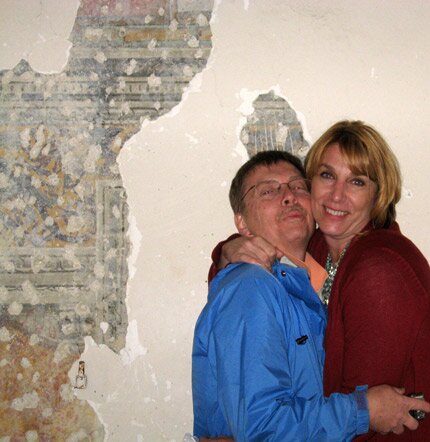
One area of the castle has been restored into an elegant suite and others are planned once they figure out how to proceed with the frescoes that they’ve discovered since the big earthquake in Assisi 10 years ago conveniently dislodged some plaster from the walls to reveal them. Here, Gary and I are “mugging” in front of them. All those holes in the fresco were gouged out by the plasterer so that the new plaster would bond better to the walls. You see this a lot throughout Italy, in many of the churches. It’s absolutely heartbreaking!
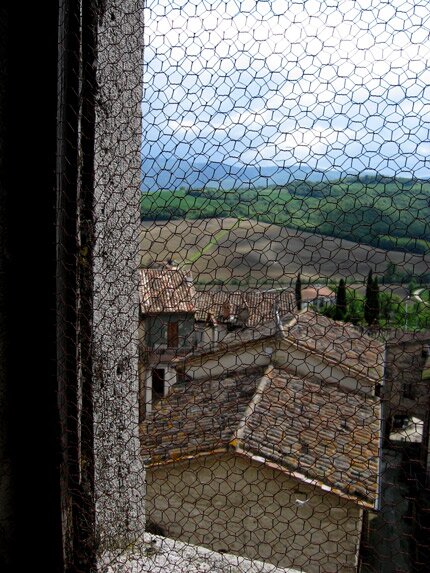
The Castello is surrounded by a small, quaint, supporting village that formerly was inhabited by a few hundred people, but now is down to about a dozen. It reminds me of a Hollywood movie set. A place frozen in time. Guest apartments have been created in some of these buildings and this is where we stayed.
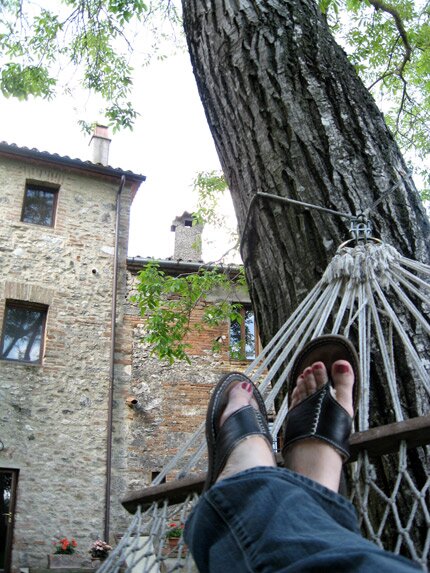
Pssst! There is a secret garden area with a tempting hammock that I had to check out one afternoon. It works! What really made the place so special, though, was the outstanding and attentive treatment by the staff, as well as the delicious lunches we enjoyed daily on the terrace overlooking the magnificent view. Romano was so pleased with our work that he treated us to an exclusive Friday night party….
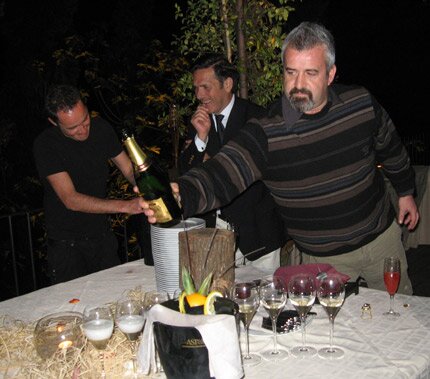
complete with local dignitaries and colorful locals-and champagne….

and even a sparkly cake!
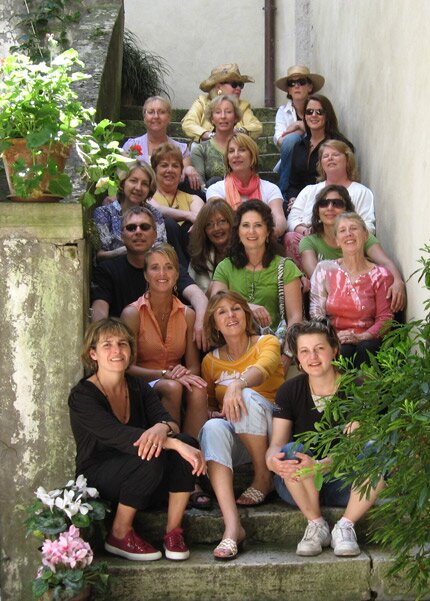
It was almost painful to leave but the bus was waiting, and we gathered one more time in the courtyard for our group photo. You can see that poor lucky Gary was the only man among the bella donnas. Seated left to right, back to front: Scooter Dykema, Rae Westermeyer, Vicki Cromwell, Patty Nickel, Sherry Fleck, Alison Wooley, Nancy Jones, Melanie Royals, Barbara Stratmetz, Gary Lord, Jan Moody, Nancy Escobar, Debbie Rye, Georgia King, Lori Slusarek, Dagmar Alexanderson, Romano’s wife Francesca and the pretty girl who worked there. Thank you to all who made this dream trip a reality!


 Copyright © Designamour